Best CO (Carbon Monoxide) Detector & Alarms

Low Pricing, Best Technology, High Accuracy, Long Life, Carbon Monoxide Gas Detector and Transmitter .

Benefits of CO Monitoring:
The very early sign in coal handling/processing plant fire is liberation of gas radicals (CO predominant). The idea is to detect the presence of this CO gas radical for very early fire prevention. By the time smoke is generated and detected it is already too late. A typical CO monitoring system for detection of products of combustion fires or spontaneous combustion of coal fires can warn potential fire two days in advance then flame is present or detected. By installing an effective CO and CH4 monitoring system, coal based power stations can benefit in the following ways:

  • Reduced insurance premiums
  • Better safety to plant and personals
  • Reduced down time
  • Prevention of loss of resources
  • Save time and money.

Why CO monitoring? :
Coal contains moisture which when liberated, coal gets oxidised, generating both heat and carbon monoxide. This heat when builds-up has the potential of creating spontaneous combustion of coal fires.
Coal is extremely friable and can be easily crumbled or pulverised. Further coal also generates coal dust needing extra preventive measures like proper maintenance of stockpiles, guarding against accumulations of coal in the fuel-handling system, compaction of stockpiles, cleaning spills and washing float dust. The most effective programme for fire-prevention would be to have Carbon Monoxide Monitoring and Control System
CO Monitoring Installation Aspects:
There will always be some safe background CO levels in coal handling or processing plants under normal operating conditions. These CO levels will rise during coal loading, handling and will again settle to normal levels once loading is finished and ventilation fans are running. It is important to find out the normal background CO levels by installing CO data-loggers and observing the CO generation trends under normal operating conditions of the plant. A typical CO level of 50 ppm of CO is normally present in background levels when coal is being handled, moved or transported. Based on these normal background CO levels the sizing/selection of the CO system (range etc) and alarm set points need to be undertaken.

Location of Sensors:
In general, it is wise practice to locate an adequate number of sensors at strategic locations based on knowledge of the potentials for ignition. When considering belt fires, sensors should be located in close proximity to drives, tail pieces, and main rollers.
When coal is the issue, any location where accumulation of coal dust or bulk quantities is likely or expected should be considered. These include belt transfers, crushers, dust collection systems, and storage bins (silos, bunkers, etc.).
System Approach:
A typical system may consist of number of CO (range: 0-300, 500 or upto 1000 ppm) and or CH4 (range: 0-100% LEL) gas sensor/transmitters installed remotely at strategic potentially risky areas. The 4-20 mA output coming from these sensor/transmitters can be connected to a multi-channel gas controller which can handle from 2 to upto 96 remote sensor/transmitters. When CO concentration levels rise beyond the set limit (say above 100 ppm, depending on safe background levels), the built in relay contacts will automatically generate audio-visual alarm for plant supervisor to take corrective measure (ventilation fans, mains shut-off etc).

Fore more details Please read our article on CO Monitoring By Mr. Alak Jha  : Articles-COearlyFire-CoalPowerPlants
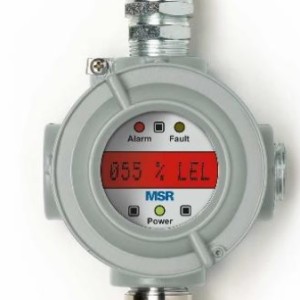
ATEX – Approved Online Sensor Transmitter

Description: 

  • Toxic and Combustible (CO, CO2, natural gas, Methane, LNG, PNG) sensor transmitter for online, continuous LEL / flammability or leakage detection in ambient air or ducts.
  • The detector is explosion proof IECEX, ATEX certified with SIL 2 safety level and suitable for installation in hazardous area Zone 1 and Zone 2.
  • The instrument can be installed at landfill application, sewage treatment plants, fertilizer industry, gas bank etc.
  • It is available with LCD Display, onboard relay contacts, flashing alarm LEDs, auto diagnostic watchdog, non-intrusive calibration, with the industry standard linear analog output.
 Combustible  gas sensor – online LEL monitor with ATEX, IECEX, SIL 2

Methane, chemically known as CH4 is highly flammable, lightweight gas with LEL at STP 5% v/v.

Methane gas detector series is highly robust, industrial grade, flameproof or explosion proof gas detector for methane leakage detection or LEL monitoring. Methane is also available in form as natural gas, pressurised natural gas (PNG), liquefied natural gas (LNG).

The detector is used for online, continuous monitoring of the flammable concentration of methane in PPM, %LEL or %Vol terms in ambient air or in duct or pipeline. It is ATEX, IECEX certified with SIL 2 safety integrity level for hazardous area installation Zone 1 and 2.

The sensor transmitter offers linear, proportional analog output in industry standard current signals, over measuring range of 0-1000, 0-2000 PPM,     0 ~ 100 % LEL (lower explosive limit). The detector works on highly sensitive catalytic bead-based pellistor sensor cell, with low response time. It has unique feature of auto diagnostic watch dog with zero point tracking feature. Due to its 12-bit microprocessor based control unit, it offer high accuracy over long term. The detector is also equipped with sintered filter with flashback arrestor for enhanced safety.

It also offers optional features like inbuilt LCD display, flashing alarm LEDs, onboard potential free relay contacts (24VDC @ 1 A), RS485 serial interface with Modbus RTU communication.

Key Features:

  • Catalytic bead based Pellistor, Electrochemical sensor cell with low flash energy
  • 12-bit microprocessor control unit
  • Non-intrusive one man calibration via hall effect switches
  • ATEX certified explosion proof / flameproof, suitable for Zone 1, 2 gas explosion installation
  • Linear, proportional analog industry standard current output
  • Continuous system self-diagnosis with watch dog
  • Flashback arrestor with sintered filter
  • Auto Zero point tracking to zero point compensation
  • SIL 2 HW TUV certified
  • RS485 serial interface with Modbus RTU communication (optional)
  • 1 or 3 relay output module (optional)
  • System and alarm LED indicators (optional)
  • Modbus RTU communication over RS485 serial interface

MSR PX2 for Combustible_Flammable Gas

Continue reading “ATEX – Approved Online Sensor Transmitter”

Online Ammonia Gas Leakage Detection

ALVI Automation in association with ALVI – Technologies feel pleased to offer Ammonia Gas Leak Sensor Transmitter in Indian and Australasian countries to stop and control the hazardous tragedy caused by leakage of Ammonia gas from the food industries like cold storage, fruit ripening chamber and also from the chemical and gas factories .

Sensor offered by ALVI Group are having all advanced and new German technologies, as all these sensor are manufactured in Germany hence the quality and reliability are assured.

Ammonia (NH3) Gas Leak Sensor Transmitter Description are as follows : 

Model no :MC2-D-E1125-C-X

Make : MSR German

  • Measuring Range : 0-300/500/1000 PPM
  • Gas Type : NH3
  • Sensor Cell : Electrochemical
  • Operating Voltage : 24 VDC
  • Output Signal : 4-20 mA or 2-10 VDC
  • Housed in IP65 polycarbonate enclosure
  • Housing UL94 V2 approved
  • Wall mount housing
  • Calibration interval : 12 month
  • Continuous Monitoring
  • High accuracy, selectivity and reliability
  • Low zero point drift
  • Long life sensor
  • Easy maintenance and calibration by exchange of the sensor unit or by comfortable on site calibration
  • Software according to SIL2 compliant development process

For more details and quote please mail us on : Info@alviautomation.com